Touring, installed, cinema, and commercial PA systems engineered for controlled coverage.
Talk to a systems specialist

Innovation here means fewer mysteries between design intent and what the audience hears. It joins acoustic measurement, transducer behavior, enclosure durability, DSP control, amplifier protection, and operator workflow into systems that can be specified, installed, tuned, and supported with confidence.
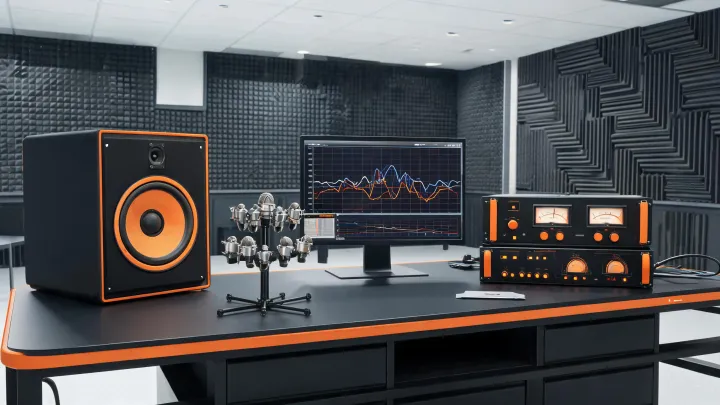
A professional audio system is judged at the moment people enter the room, not when a feature sheet is printed. The innovation program therefore focuses on the links that most often decide whether a project feels controlled: coverage, output margin, low-frequency behavior, protection, network visibility, and human operation. Each priority connects laboratory work to a field decision. Measurement helps narrow the loudspeaker family. DSP tools help translate system geometry into repeatable settings. Amplifier data helps service teams notice stress before it becomes downtime. Documentation helps dealers and operators understand why a package was chosen.
| Innovation track | Engineering focus | Field value |
|---|---|---|
| Coverage modeling | Directivity, throw distance, fill behavior, and interaction between mains, delays, and balconies. | Fewer blind spots, fewer hot seats, and cleaner speech across audience zones. |
| Low-frequency control | Subwoofer placement, pattern selection, phase relationship, and power margin. | Impact that stays focused on the audience instead of building on stage or outside the room. |
| Networked electronics | Amplifier monitoring, DSP presets, mixer routing, and simplified status visibility. | Operators can diagnose quickly and keep the system inside the intended operating window. |
| Deployment knowledge | Rigging notes, service access, labeling, setup guides, and dealer handoff packages. | Installers and crews spend less time decoding the design and more time verifying the room. |
The checklist is intentionally practical. It is not a trophy wall; it is a way to keep product recommendations from drifting away from the room. A loudspeaker path should be reviewed against audience geometry. A subwoofer plan should be tested against the stage and boundary behavior. An amplifier and mixer package should be checked for headroom, I/O, user access, and future service. A monitor setup should respect the performers and the front-of-house mix. When these checks are visible, the buyer understands the tradeoffs before purchase, and the dealer has a stronger basis for the final package.
Innovation only earns trust when it is honest about cost. Most JBL Professional decisions are not a single right answer but a balance the buyer should see before purchase. The comparison below frames the recurring debates by option, advantage, and the constraint that comes with it, so a touring, cinema, or install package can be judged on the trade-off that actually matters for that room.
| Decision point | One option and its gain | The competing option and its cost |
|---|---|---|
| Cinema vs. touring voicing | Cinema screen-channel and surround tuning targets reference playback and even seat-to-seat dialogue, ideal for fixed auditoriums. | Touring main voicing trades that reference flatness for output headroom and rigging speed, so a cinema preset rarely suits a festival stage and vice versa. |
| Maximum SPL vs. thermal headroom | Pushing a compact cabinet to its peak rating delivers more apparent loudness from fewer boxes on a tight budget. | Running near peak invites power compression and protection limiting over a long show; reserving headroom keeps tone stable but needs more cabinets or amplifier channels. |
| Integrated transducer + DSP vs. open component choice | A matched transducer, waveguide, and preset package gives predictable behavior with minimal tuning risk out of the box. | Mixing components for a custom requirement adds flexibility but shifts measurement, protection, and alignment responsibility back onto the integrator. |
| Networked monitoring depth vs. operator simplicity | Deep amplifier and mixer telemetry lets a managed campus catch stress before downtime and recall presets remotely. | That depth raises commissioning effort and can overwhelm volunteer operators, where a simpler control surface would lower the support burden. |
A validation pass is also where the honest boundaries get written down. JBL Professional output is engineered to a defined coverage and SPL target, not to an unlimited claim, so any request beyond the agreed audience geometry is flagged rather than assumed. Sustained level is bounded by amplifier thermal and power-compression behavior, low-frequency control degrades when a venue cannot accommodate cardioid or end-fire sub spacing, and networked electronics depend on a maintained data path plus a trained operator. Outdoor and high-moisture sites require weather-rated enclosures and protected racks. Naming these limits early is what keeps a quote from becoming a promise the room cannot keep.
Share the venue, event profile, and operating team. We will focus the conversation on the technical behaviors that determine whether the system feels effortless after installation.
Request an Innovation Review