
Touring, installed, cinema, and commercial PA systems engineered for controlled coverage. Talk to a systems specialist
Brand Logo
Applications

JBL Professional audio for demanding commercial spaces

Different venues fail in different ways. A touring stage can lose consistency from one trim height to the next, while a conference room can lose speech detail because the far end hears reflections before words. Application planning keeps the product conversation tied to the job each room has to do.

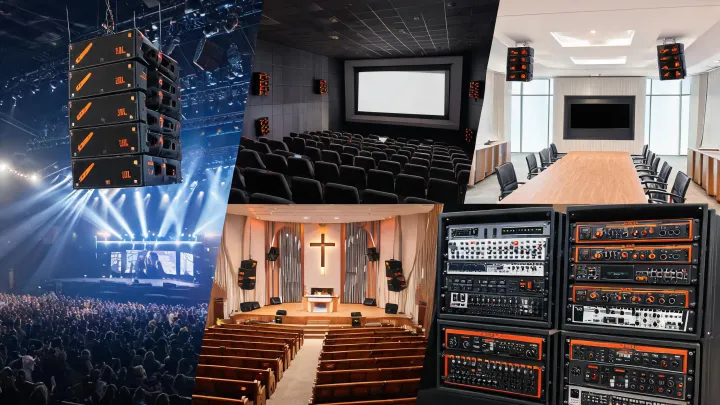
Commercial venue audio applications collage
Venue fit

Application notes that change the speaker choice

Products should not be selected by name recognition alone. A loudspeaker family that works in a club may be the wrong answer for a reflective atrium. A subwoofer deployment that feels powerful at a festival can overwhelm a worship room if the stage and seating are close together. A mixer that is comfortable for a touring engineer may be too complex for a school auditorium operated by volunteers. The application list below shows how JBL Professional system thinking adapts the same product categories to different real-world constraints.

Touring systems prioritize fast deployment, predictable coverage, rugged handling, and repeatable presets. Line array elements, subwoofer patterns, monitor packages, and amplifier racks must be advanced before load-in so the crew can adapt to height, width, audience depth, and local power without reinventing the show.

Permanent systems need clear speech, musical headroom, sightline-sensitive mounting, and a service path that a local team can maintain. The best loudspeaker selection often combines mains, delays, front fills, stage monitors, and control layers rather than one oversized cabinet doing every job.

Cinema rooms depend on screen channel alignment, surround coverage, controlled low-frequency extension, and consistent playback across seating rows. Product choices must respect acoustic treatment, projection geometry, amplifier protection, and the operational expectations of theater staff.

Meeting rooms, divisible spaces, and hybrid conference areas need intelligibility at low fatigue levels. PA speakers, ceiling devices, mixers, and DSP settings must support speech, remote participants, presentation playback, and simple operator control without visible clutter.

Distributed audio in public environments is shaped by zone volume, background music quality, announcement clarity, architectural limits, and simple service. The system must sound intentional at low levels while remaining ready for events, alerts, and changing occupancy.

Campus systems often serve assemblies, lectures, theater, music programs, and rentals. The audio design has to balance ease of use, durable hardware, flexible inputs, monitor support, and documentation that survives staff changes over many semesters.
Selection considerations

Where two valid loudspeaker choices pull in opposite directions

Application planning is mostly a series of honest trade-offs. There is rarely one correct answer across touring, cinema, and installed work, so the points below lay out the competing positions JBL Professional teams weigh per room. Each one names what you gain on one side and what you give up, because hiding the cost of a decision is how commercial audio projects drift over budget.

Line array vs. point-source coverage

A flown line array buys long, even throw and tight vertical control for deep audiences, but adds rigging load, trim-height planning, and longer setup. A point-source or column system is faster to deploy and easier to service in a low-ceiling install, yet loses reach and uniformity in a 2,000-plus seat room. The choice follows audience depth and rigging access, not which cabinet looks more capable on paper.

Cardioid/end-fire subs vs. a single stacked array

Cardioid and end-fire subwoofer layouts cut energy spilling onto the stage and into neighbor zones, which protects monitor mixes and noise-sensitive venues. The cost is more cabinets, more amplifier channels, and tighter alignment work. A single ground-stacked array is cheaper and simpler, but accepts stage rumble and uneven low-frequency coverage across the floor.

Powered cabinets vs. passive boxes on external amps and DSP

Self-powered loudspeakers shorten cabling and travel light for portable PA work, with onboard protection per box. Passive cabinets driven by rack amplifiers and networked DSP give an install team central tuning, easier component service, and headroom margin to grow zones later. Touring crews often favor powered convenience; permanent venues usually favor the serviceability of separated electronics.

Networked DSP presets vs. operator-facing analog control

Networked amplifier and mixer ecosystems give remote monitoring, recallable presets, and fault visibility, which suits multi-room campuses and managed installs. Simpler analog-front control is more forgiving for volunteer or rotating operators who should not have to navigate a network UI mid-event. The right answer depends on who maintains the system after handoff, not on feature count.

Known limits we state up front: JBL Professional systems are sized to documented SPL and coverage targets, so output beyond the agreed audience geometry is not assumed; sustained high output is bounded by amplifier thermal and power-compression headroom; outdoor and high-humidity installs need weather-rated enclosures and protected electronics; and every package depends on correct commissioning and routine service to hold its tuned performance.

Match the application

Send the room type and event profile before choosing the cabinet.

We will help identify the product families, electronics, and support questions that belong in the first dealer conversation.

Map My Application